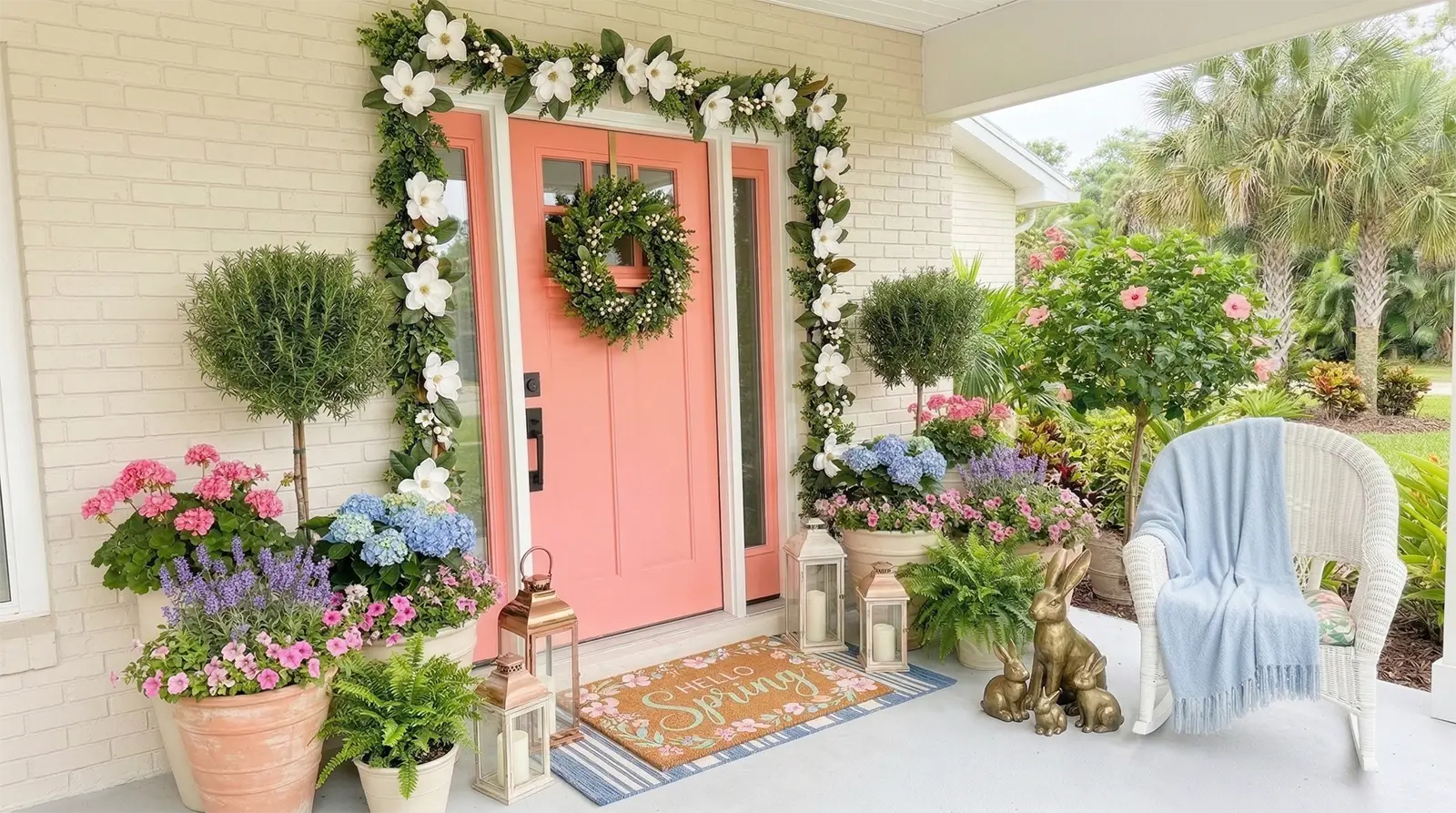

Spring in Northeast Florida has a short window — the air softens, the neighborhood comes alive, and your porch gets noticed. Here are 25 ideas we’ve refined across 200+ local installs to help you make the most of it.
1. Layered Rugs & a Statement Welcome Mat
Ask any designer what the most overlooked element of porch styling is, and the answer is almost always the floor. Before a single plant goes down or a chair gets placed, the ground beneath everything sets the tone. It’s the foundation we address on every single install — and it’s the one thing homeowners almost never think about on their own.
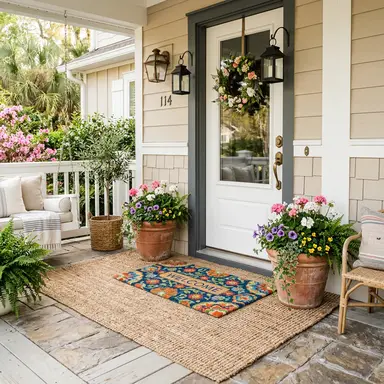
Layer two outdoor rugs for instant depth
Start with a larger, neutral-toned outdoor rug — something in jute, sisal, or a flat-weave in cream or warm gray — and layer a smaller, bolder welcome mat on top. The two-rug technique creates visual depth that a single mat never can, making even a modest porch feel designed rather than default. In our experience across dozens of First Coast installs, UV-resistant polypropylene-backed options hold up best against Florida’s sun and afternoon humidity — we’ve seen cheaper materials fade within a single season.
Coordinate your mat color with one other element
Here’s a small trick that makes a disproportionate difference: pick a welcome mat that echoes a color already present somewhere else on your porch. Match it to your door paint, a cushion accent, or the tone of your planters. This one thread of color continuity makes the entire space feel curated instead of cobbled together. It’s one of the first things our lead designer checks during a consultation — that connective color thread.
Retire the generic welcome mat
If your mat just says WELCOME in faded block letters and it’s been there since you moved in, it’s time. Swap it for something with a spring botanical print, a bold geometric, or even a cheeky seasonal message. It’s the cheapest possible signal to every person who approaches your door that somebody here pays attention to the details — and in our neighborhood walkthroughs, it’s the first thing that registers from the sidewalk.
2. Go Vertical: Hanging Planters & Tiered Displays
Most porches only use floor space — which means they’re leaving half their potential empty. Vertical gardening draws the eye upward, fills a porch without crowding the walkway, and is especially powerful on smaller stoops where square footage is premium. We install vertical displays on about 70% of our projects because the visual impact per square foot is unmatched.
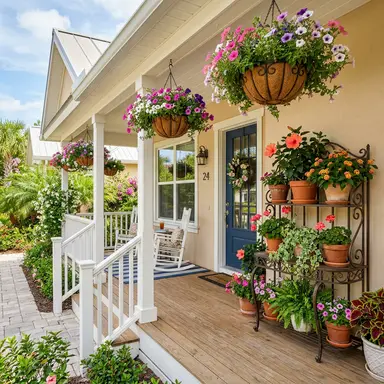
Hang cascading petunias or trailing ivy
Nothing says “this porch is alive” quite like hanging baskets overflowing with trailing petunias, ivy, or sweet potato vine. They create immediate volume and movement, and from the street they give the impression that your home is wrapped in greenery. The honest trade-off: hanging baskets in Florida sun dry out fast. We tell our clients to plan on daily watering unless they’re hanging them under roof cover where they’ll get bright indirect light and stay hydrated longer.
Create height variety with a tiered plant stand
Group your plants at three different levels — something tall on the floor, a mid-height arrangement on a stand or stool, and a hanging basket above. This layered approach looks intentional and lush rather than sparse and random. It also photographs beautifully if you’re ever listing the home — check our gallery for real examples of how height variety transforms a Northeast Florida porch.
Choose plants that can handle a Florida spring
Here’s the thing most spring decor guides won’t tell you: those gorgeous tulips and hyacinths everyone on Pinterest recommends are cool-climate plants. In Northeast Florida, they’ll be fried by mid-April. We’ve tested dozens of species across our residential installs, and the consistent winners are Lantana, Pentas, Hibiscus, and Purslane. They thrive in full sun, bloom in stunning colors, and keep going strong well into summer without babysitting. If you want spring color that doesn’t quit on you, these are your plants.
Mix real plants with high-quality faux accents
This is the move most people won’t admit they’re making — but should. Combine one or two real statement plants (a potted palm, a flowering Hibiscus) with faux greenery accents like an artificial boxwood ball or a faux eucalyptus garland. Modern faux plants are genuinely hard to tell apart from the real thing — we use them in our own installs regularly, and clients are routinely shocked when we point out which ones aren’t alive. For any full-sun spot with no irrigation, it’s not cheating. It’s designing for climate.
3. Set the Mood: String Lights & Layered Lighting
Florida spring evenings are the real sweet spot — warm enough to sit outside with bare feet, cool enough that you’re not melting. A well-lit porch extends that window by hours, turning a walkway into a place people actually want to linger. Lighting is the one category where we see the most dramatic before-and-after reactions from homeowners.

String Edison bulb lights across the ceiling
Warm-toned bistro lights are the single fastest way to make any porch feel like a destination. Drape them across ceiling beams, stretch them between columns, or weave them along a railing — the specific placement matters less than the warm glow they cast. We specify 2700K warm white for all our installs — it produces that golden-hour ambiance every evening without washing out in the Florida sunset.
Flank the door with oversized lanterns
Two matching lanterns on either side of your front door — it’s a design move that’s been working for centuries and still hasn’t gotten old. Fill them with LED pillar candles for a no-maintenance, no-fire-risk glow that looks incredible after dark. Trending finishes for 2026 lean toward matte black and antique brass, both of which pair with basically any home style from coastal traditional to modern farmhouse. We keep both finishes in stock because we use them that frequently.
Swap that outdated porch light fixture
That old coach light or tarnished brass fixture next to your door? It’s quietly aging your entire front facade — and we see it on nearly every pre-consultation walkthrough. A modern fixture in matte black, brushed nickel, or oil-rubbed bronze typically runs $60–$120 and can be swapped in under an hour. For the cost involved, it’s one of the highest-ROI curb appeal moves you can make. Our team can handle the swap during a standard install visit.
4. Create a Seating Moment
A porch with nowhere to sit is just a hallway with a roof. Add intentional seating and you transform it into an outdoor room — one that signals to every passerby that this home is actually lived in, not just maintained. In our experience, seating is the upgrade that gets homeowners using their porch daily rather than walking past it.
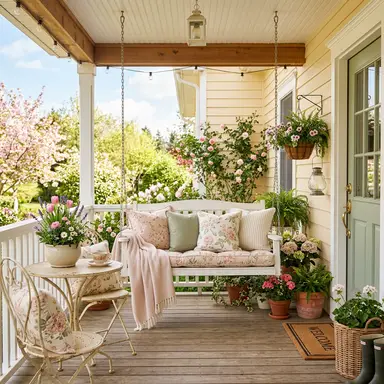
Invest in a classic porch swing
There’s a reason the porch swing has never gone out of style. It invites you to slow down in a way no chair can. Dress it with cushions in a soft stripe or muted floral, and it becomes both the visual anchor of the space and the spot everyone gravitates toward. If your porch has the structural support, this is the single best piece of furniture you can add — we’ve installed dozens across the Jacksonville area, and it’s consistently the element homeowners mention first in their feedback.
Pick chair frames with swappable cushion covers
The smartest long-term porch investment isn’t an expensive chair — it’s a durable, all-weather frame with removable cushion covers you can swap seasonally. Spring florals in March, tropical brights in June, warm neutrals in October. Same furniture, completely different porch, for the cost of a couple of cushion covers each season. We recommend this approach to every client on a seasonal plan — it keeps the porch feeling fresh without recurring furniture costs.
A bistro set transforms even a tiny stoop
Don’t have a sprawling veranda? A two-piece bistro set — a small round table and two folding chairs — can make a three-step stoop feel like a Parisian café. Wrought iron or powder-coated aluminum holds up beautifully outdoors in Florida’s salt air, and painting them in a pop color like sage green or terracotta adds personality without overwhelming the space. Some of our favorite projects have been small-porch transformations — proof that square footage isn’t what makes a porch great.
Layer in texture with pillows and a lightweight throw
The finishing touch that separates a functional porch from a styled one: outdoor cushions in soft spring pastels (blush, sage, butter yellow) and a lightweight throw draped casually over one armrest. These textile layers add warmth, color, and the undeniable impression that this space was designed, not just furnished. We source Sunbrella and similar UV-rated fabrics for all our cushion packages because they hold their color season after season in direct Florida sun.
5. Faux Greenery: The Smart Move for Florida Heat
Let’s stop pretending faux plants are a compromise. In 2026, the artificial greenery market has caught up to reality — UV-stabilized finishes, real-touch textures, and color variation so nuanced you genuinely can’t tell without touching it. For a state where “spring” lasts about six weeks before it’s 90 degrees with afternoon thunderstorms, faux is practical design, not lazy decorating. We use commercial-grade faux elements in roughly a third of our installs, and the results speak for themselves in our project gallery.
Flank the door with faux olive trees or topiaries
Two matching faux olive trees in tall ceramic planters, one on each side of the front door. That’s it. The symmetry alone is stunning, the “Mediterranean Modern” aesthetic is everywhere in 2026, and unlike real topiaries these won’t scorch in a west-facing sun exposure or drown during a week of Florida downpours. We’ve placed these on porches from Atlantic Beach to Palm Coast, and they consistently look as fresh a year later as the day they were installed.
Go for a lush, garden-fresh faux wreath
The wreath trend for spring 2026 leans abundant and slightly wild — think overflowing peonies, lavender sprigs, and mixed greenery that looks like someone gathered it from an English garden that morning. A high-quality faux version stays perfect through humidity, spring rain, and three-day weekends away. No wilting, no browning, no replacing it midseason. Our design team sources wreaths with real-touch petal technology that even up close read as fresh-cut.
Use faux boxwood planters as a polished anchor
Low rectangular boxwood planters work with almost any porch style — coastal, traditional, farmhouse, modern. They add clean structure without competing with the rest of the decor. And the faux version means they look exactly the same on day one as they do three years later. No watering. No trimming. No replacing. That’s a rare kind of design consistency, and it’s why these are one of our most-requested elements.
6. The 2026 Color Palette Guide
Color is the fastest, lowest-effort way to make a porch feel current. You don’t need to rebuild anything — just shift the tones. After surveying this year’s design trends and pairing them with what we’re seeing work on actual Northeast Florida homes, here are the palettes leading the conversation this spring.
Soft pastels: blush, sky blue, and sage green
The dominant spring palette for 2026 is soft to the point of being airy — blush pink, sky blue, and muted sage green. You’re seeing it everywhere from national shelter magazines to Nextdoor posts from your own neighborhood. The trick to keeping it sophisticated rather than Easter-basket? Anchor the pastels with at least one strong neutral: white linen, natural rattan, raw wood, or warm gray stone. We learned this balance the hard way over many installs — pastels without an anchor can read juvenile rather than elegant.
Warm earthy neutrals: terracotta, sand, and clay
This palette feels especially native to Northeast Florida’s coastal landscape. Terracotta pots, a sand-colored woven rug, teak or cypress wood furniture, and warm-toned cushions in muted clay. It’s easier to pull off than pastels, pairs with literally any door color, hides outdoor dirt and wear gracefully, and transitions seamlessly from spring into summer without looking dated. This is our go-to recommendation for clients who want a “set it and forget it” aesthetic.
A bold front door color changes everything
If you only do one thing from this entire list, repaint your front door. A single quart of exterior paint and a Saturday afternoon is all it takes, and the transformation is disproportionate to the effort. Deep forest green, naval blue, and rich matte black are the trending picks for 2026 — all of them adding depth and sophistication regardless of the rest of the porch. We’ve documented this transformation across enough of our projects to say with confidence: nothing else on this list delivers as much visual change per dollar.
Let natural materials be the common thread
Rattan. Wicker. Jute. Terracotta. Ceramic. Wood. These materials have a warmth and texture that synthetic furniture and plastic planters simply cannot replicate. When natural materials form the foundation of your porch, every element on top of them — the cushions, the plants, the lighting — looks better by association. Even from the street, the difference is palpable. It’s one of the core principles in how we approach every project.
7. The Finishing Details That Set Your Porch Apart
The gap between a nice porch and the one that stops people mid-walk is almost never about big-ticket items. It’s about a handful of deliberate, low-cost details that communicate care. These are the elements our team adds at the end of every install — the “last 10%” that accounts for most of the wow factor.
Create symmetry with matching planters
Place two matching planters — even simple, affordable ones — on either side of your front door. That’s it. The symmetry alone generates a sense of order and intentional design that instantly elevates everything else around it. The plants inside don’t need to match; mixing heights and textures within matching vessels actually looks more dynamic than identical plantings. This is far and away the most common recommendation we make during free consultations.
Upgrade your address numbers
Most homes are still wearing the builder-grade brass or stick-on numbers that were there on closing day. Swapping them for oversized matte black numerals, a painted wooden sign, or a ceramic tile marker takes about twenty minutes and costs under $40 — but it registers with every visitor and buyer, even if they can’t articulate why the house feels more polished. We’ve started including address marker upgrades in our premium packages because the impact-to-cost ratio is absurd.
Replace dated door hardware
A new handle, knocker, and kickplate in a matching finish — matte black or antique brass — makes a front door look custom and considered. Combined with a fresh coat of paint, this sub-$100 upgrade essentially gives you a brand-new front entrance without actually replacing the door. It’s one of the quickest wins our installers execute, and it pairs beautifully with a new seasonal wreath above it.
Add a sensory element: a water feature or wind chime
The most memorable porches engage more than just the eye. A small tabletop fountain with a gentle trickle, or a well-chosen wind chime in a deep tone — these ambient sounds create an experience that begins before the front door even opens. In Florida, where the porch is a genuine living space from March through November, sensory details aren’t extras. They’re how the space actually gets used. Several of our clients in Ponte Vedra and Jacksonville Beach have told us the sound element was the detail that finally made their porch a daily ritual rather than a pass-through.
A Note for Our Northeast Florida Neighbors
If you’re reading this from Jacksonville, Ponte Vedra, Nocatee, St. Augustine, or anywhere along the First Coast — you already know that “spring” here has an expiration date. By early May, the humidity arrives and outdoor projects become a race against afternoon thunderstorms and heat indices that laugh at comfortable.
The window to act is now. March and April are the months to get your porch dialed in — and the smart move is to build it for transition. Choose heat-tolerant plants that won’t need replacing in six weeks. Pick UV-resistant fabrics that won’t fade before summer. Design a setup that can shift from spring to summer with a wreath swap and a cushion change, not a full teardown. We’ve been designing porches on the First Coast for years, and the porches that look best in July are always the ones that were planned in March.
Ready to Skip the Weekend Project?
Reading a list of 25 ideas is the easy part. The hard part is sourcing everything, hauling it home, figuring out what goes where, realizing you bought the wrong size rug, returning it, and losing an entire Saturday to something that still doesn’t look quite right.
That’s exactly what our team exists for. At Porch Inspire, our Northeast Florida designers handle everything — concept, sourcing, delivery, and installation — in a single visit. You wake up with a porch that needs work. By the evening, your neighbors are texting you asking who did it.
No weekends lost. No trips to three different stores. No “I’ll finish it next weekend” that turns into next month.
Browse our seasonal packages or reach out to our design team — we’d love to help you make this the spring your porch finally gets the attention it deserves.